Implementers

Open release hub

Everything you need to build or evaluate OESIS: sensor hardware specs, software service guides, data contracts, and architecture indexes for the current release. If you want to see how the pieces connect visually, start with the Diagrams page.

New here? Start with the Program overview for an overview of the initiative, or Governance and privacy for ownership, sharing, and data boundaries.

Specification links open the public GitHub program-specs repository in a new tab.

Implementers

First build path

Run one slice end to end—bench-air-class hardware through published software contracts—before branching to other modules.

  1. Bench Air (hardware hub)

    Start from the released indoor / sheltered air node on the hub.

  2. Software specs

    Ingest, inference, and parcel platform contracts linked from the hub.

  3. Diagrams

    Architecture flow diagrams before you open implementation-heavy repos.

  4. v1.0 scope (program-specs)

    Honest status table—opens the public repo in a new tab.

Trust boundary

What is open—and what stays private by default

  • The public release surface is intentionally scoped: specs, guides, and architecture indexes — not an unfiltered dump of every internal file.
  • Future participant parcel-linked raw data is not public by default; governance describes ownership, data classes, and opt-in sharing.
  • Parcel-state style outputs are estimates and inferences for judgment—they do not replace official alerts or emergency authority.
  • When something is still research, staged, or not yet cleared for publication, the site should not read as if it were already fielded product.
  • For policy detail, use Governance and privacy; for exact publication boundaries, follow the v1.0 open-release packet and linked contracts.

Release packet

OESIS open release packet

Release-scoped public packet and publication boundary for the project site; canonical markdown roots under release/v1.0/.

TL;DR

Hardware specs

Open hardware modules cover indoor air, sheltered outdoor reference, optional flood points, and a privacy-minded thermal option. Each has build and firmware docs for makers.

released

Bench Air Node

Indoor or sheltered air reference and the quickest way to get real readings through the full stack.

Technical detail and doc linksExpand

Produces the first repeatable indoor or sheltered parcel evidence and exercises the full ingest-to-parcel-view path.

Why it matters: It is the fastest hardware route from concept to trustworthy parcel evidence.
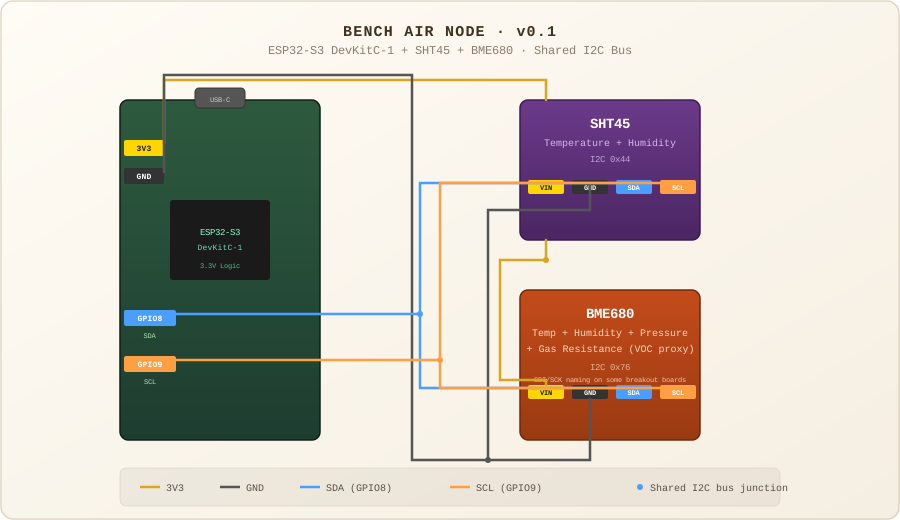
Bench Air Node wiring: ESP32-S3 DevKitC-1 connected to SHT45 and BME680 over shared I2C bus.
Bench Air Node wiring diagram

Relevant diagrams: System context, Recommended first integrated prototype
next

Mast-Lite Outdoor Node

Sheltered outdoor reference for weather and air at the edge of the parcel.

Technical detail and doc linksExpand

Adds sheltered outdoor parcel context without waiting for the richer mast build.

Why it matters: It is the simplest outdoor step that turns a single-structure slice into a fuller parcel kit.

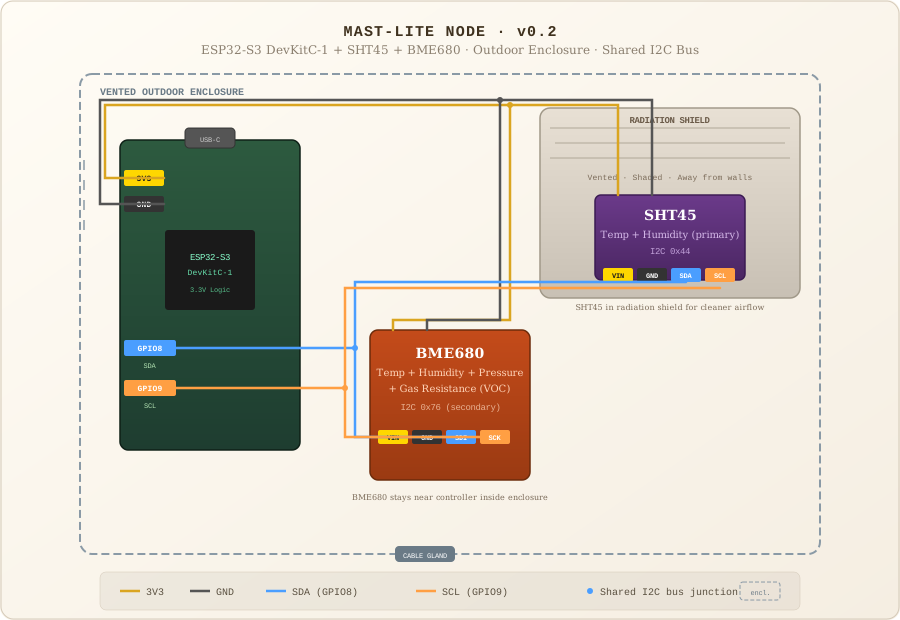
Mast-Lite Node wiring: ESP32-S3 with SHT45 in radiation shield and BME680 near controller, inside vented outdoor enclosure.
Mast-Lite Outdoor Node wiring diagram

Relevant diagrams: Recommended first integrated prototype, Parcel view surface

next

Flood Node

Optional low-point runoff evidence where parcel context makes it operationally relevant.

Technical detail and doc linksExpand

Measures low-point runoff evidence while staying explicit that one point is not the whole parcel story.

Why it matters: It adds flood-specific evidence without pretending a single sensor point is parcel-wide truth.

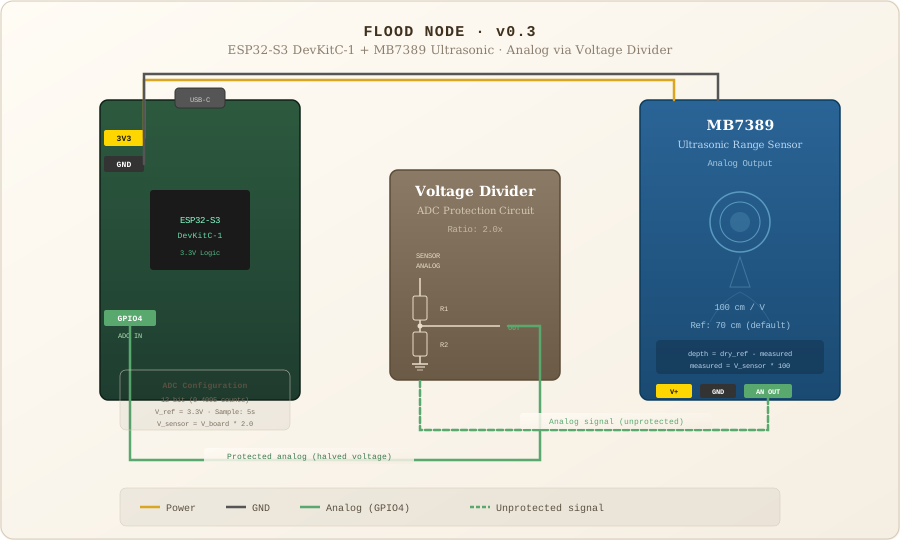
Flood Node wiring: ESP32-S3 connected to MB7389 ultrasonic sensor via voltage divider on GPIO4.
Flood Node wiring diagram

Relevant diagrams: Recommended first integrated prototype, Data-rights and visibility boundary

planned

Weather + PM Mast

Second-wave outdoor mast for richer particulate and weather context at parcel edge.

Technical detail and doc linksExpand

Extends outdoor evidence beyond mast-lite by adding a weather-plus-particulate hardware path with dedicated build and firmware docs.

Why it matters: It is the upgrade path when teams need stronger outdoor PM and weather evidence than the first sheltered-outdoor step.

Relevant diagrams: System context, Parcel view surface

planned

Circuit Monitor

v1.5 bridge hardware for read-side equipment-state evidence from CT-clamp current signals.

Technical detail and doc linksExpand

Captures HVAC and sump-adjacent equipment state as an explicit evidence stream, including cycle and confidence metadata.

Why it matters: It supports the hazard-to-response bridge by adding measured equipment behavior without implying full controls automation.

Relevant diagrams: System context, Data-rights and visibility boundary

planned

Thermal Pod

Research-gated derived thermal scene metrics without raw imagery persistence.

Technical detail and doc linksExpand

Provides area-level thermal context through privacy-safe derived metrics rather than stored frames.

Why it matters: It opens a path to scene sensing while preserving the project’s privacy posture.

Relevant diagrams: Parcel view surface, Data-rights and visibility boundary

TL;DR

Software specs

Software pieces cover the parcel app, ingestion, inference, and optional neighborhood map outputs—each documented for implementers.

next

Parcel Platform

The dwelling-facing app and API surface for parcel status, evidence, and freshness.

Technical detail and doc linksExpand

Turns parcel-state outputs and evidence summaries into a usable parcel view without hiding uncertainty.

Why it matters: It is the main product surface where parcel awareness becomes usable rather than buried inside pipeline internals.

Relevant diagrams: System context, Parcel view surface

released

Ingest Service

Validates device packets and external feeds, then normalizes them into canonical observations.

Technical detail and doc linksExpand

Creates the evidence boundary that turns raw packets into the parcel-first information model.

Why it matters: It is the place where raw measurements become consistent, inspectable evidence for the rest of the system.

Relevant diagrams: System context, Recommended first integrated prototype
released

Inference Engine

Combines observations and context into parcel-state outputs with explicit uncertainty.

Technical detail and doc linksExpand

Turns normalized evidence into parcel-state guidance while keeping reasons, freshness, and confidence visible.

Why it matters: It is where parcel evidence becomes parcel-state guidance without pretending sparse evidence is certainty.

Relevant diagrams: System context, Data-rights and visibility boundary

next

Shared Map

Optional coarse neighborhood outputs built from policy-gated shared signals.

Technical detail and doc linksExpand

Creates a neighborhood condition layer that remains downstream of parcel ownership and sharing controls.

Why it matters: It is the part of the stack where network effects become visible without exposing raw parcel data.

Relevant diagrams: System context, Data-rights and visibility boundary

TL;DR

Core released spec collections

Indexes for architecture, data contracts, and build guides—jump in here if you are implementing against the open release.

Architecture

Versioned architecture and operating model

How hardware, software, identity, and governance fit together across versions.

Contracts

Schemas and canonical contracts

Formal definitions for parcels, nodes, observations, and sharing behavior.

Build guides

Hardware assembly and deployment guidance

Cross-subsystem references for building, procuring, and installing the parcel kit.

TechnicalFull descriptions and repository linksExpand
Top